Model
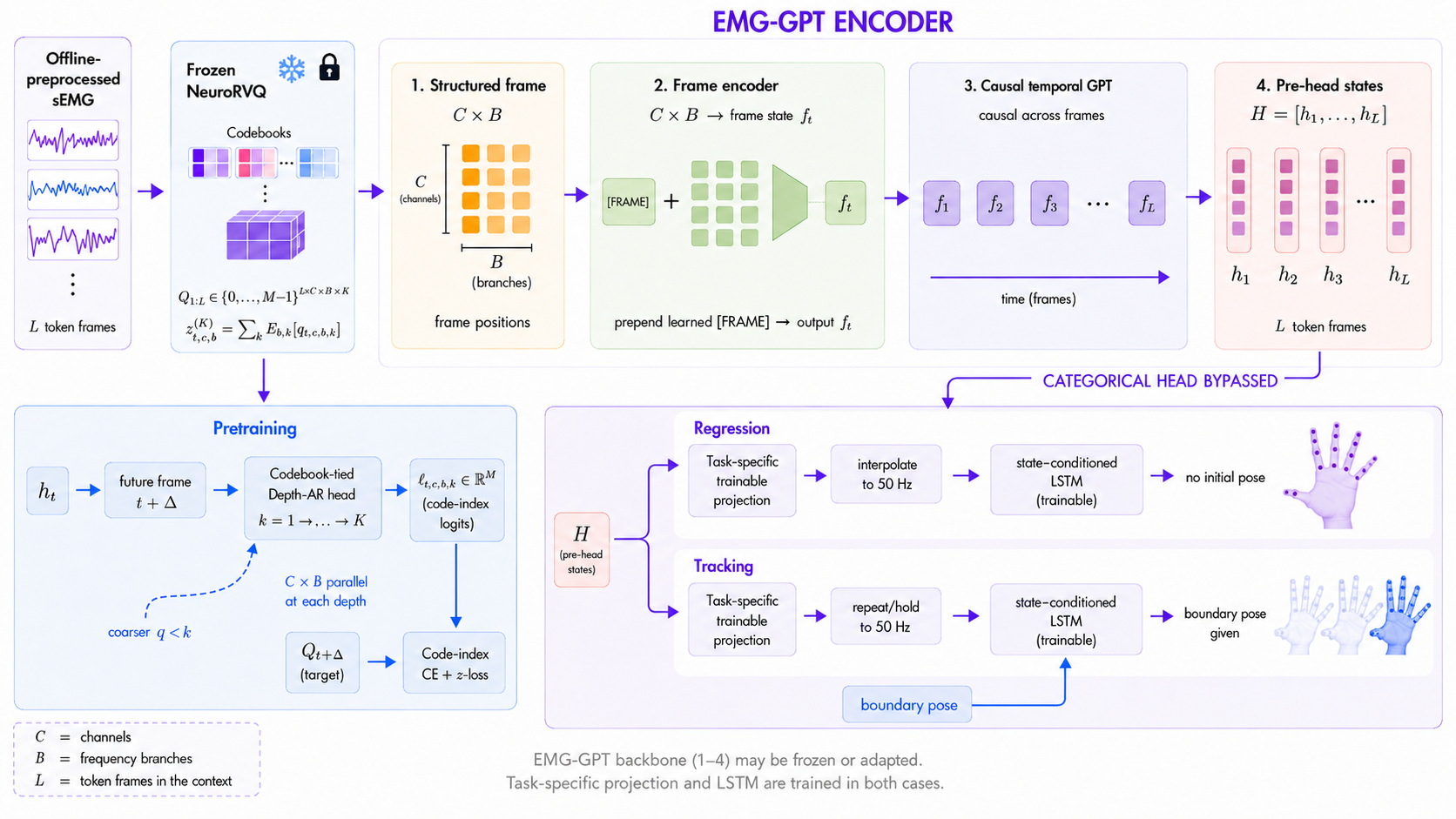
Designed the intra-frame encoder and 8-layer causal temporal Transformer over structured RVQ tokens.
Preprint · arXiv · October 2026
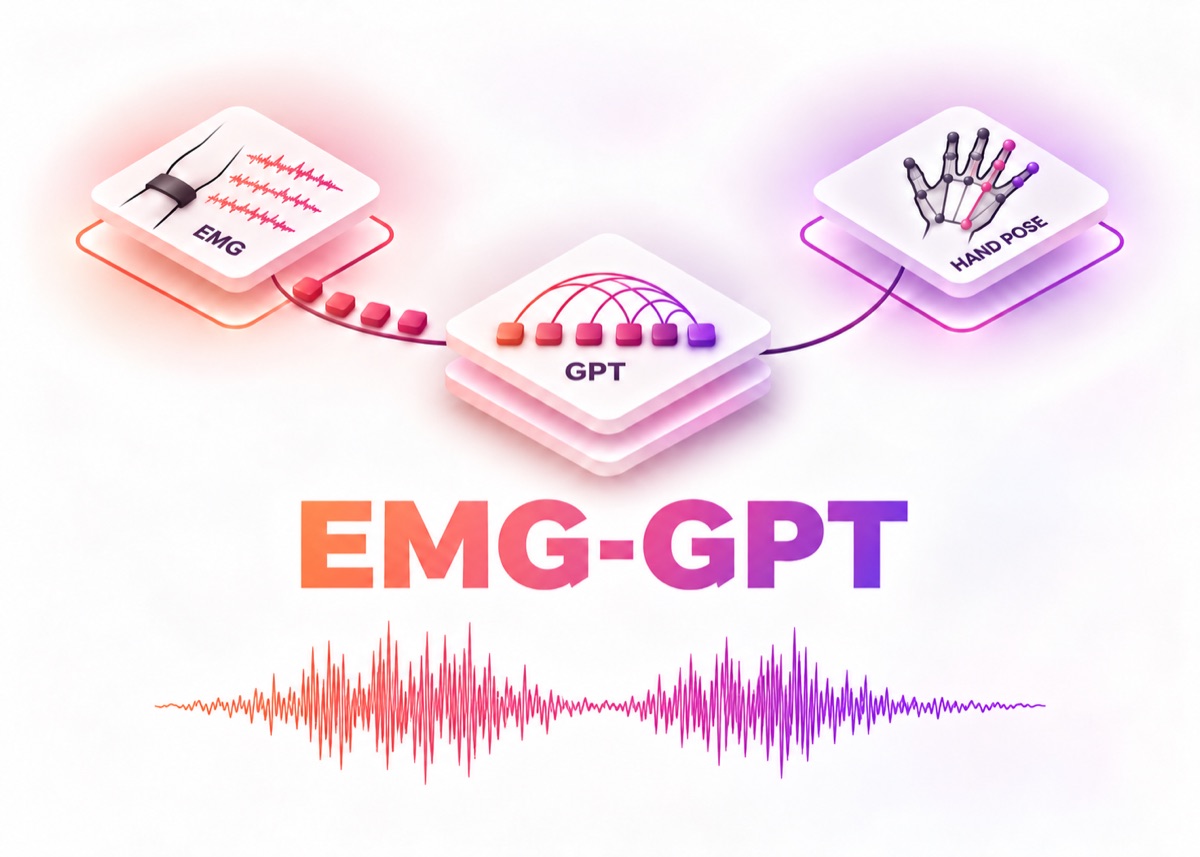
A causal Transformer that learns from wrist EMG alone, then transfers to continuous 3D hand-pose estimation on people it has never seen.
01 · See the result
Choose a sequence
Top: motion-capture target. Middle: EMG-GPT. Bottom: vEMG2Pose baseline. Drag the timeline to inspect any frame.
02 · How it works
A frozen NeuroRVQ tokenizer turns 16-channel EMG into discrete codes.
Each 40 ms frame of electrode × frequency codes becomes one state.
A causal GPT predicts the codes 200 ms ahead, coarse to fine.
Learned states feed a pose decoder for 20 joint angles.
03 · Results
Re-running the released vEMG2Pose weights on exactly the same test samples gives the same new-user error.
Lower error than SensingDynamics and NeuroPose in every generalization setting.
04 · Why pretraining matters
Same pose decoder with the GPT frozen; only the pretraining checkpoint changes (0 = random GPT). Validation set, seed 123.
Scaling observation
Scaling capacity as high as 97.4M parameters did not materially improve transfer. For this problem, preserving the right structure mattered more than indiscriminate scale.
05 · My contribution
Designed the intra-frame encoder and 8-layer causal temporal Transformer over structured RVQ tokens.
Built reproducible PyTorch and Slurm workflows for large experiments on Isambard-AI.
Ran matched baselines, held-out-user evaluation, multiseed checks and deterministic visualisation.
Open-sourced an installable inference package and both checkpoints on Hugging Face.
@misc{magni2026emggpt,
  title={EMG-GPT: Predictive Pretraining on Residual-Quantized EMG Tokens for Hand Pose Estimation},
  author={Ettore Magni and Rolandos Alexandros Potamias and Stefanos Zafeiriou and Konstantinos Barmpas},
  year={2026},
  eprint={2610.05235},
  archivePrefix={arXiv},
  primaryClass={cs.LG},
  url={https://arxiv.org/abs/2610.05235}
}
Comparisons with published baselines are descriptive, not claims of benchmark superiority. Weights are released under CC BY-NC-SA 4.0 and the inference code under CC BY-NC 4.0; the NeuroRVQ tokenizer is by Barmpas et al. Public redistribution of the qualitative video clips is still subject to a final licence check.
Signal Mode disabled.